No candidates yet?
Generate and discover new candidates from your target.
AI Cloud brings 40 hosted models and computational tools — antibody design, protein structure, molecular generation, docking, ADMET, and gene editing — into a single workspace. Explore the theory computationally, and save the lab for what truly matters.
AI Cloud helps you find, evaluate, and select the candidates worth testing.
No candidates yet?
Generate and discover new candidates from your target.
Too many candidates to test?
Compare and prioritize candidates before experiments.
Need to understand binding?
Predict structures and evaluate target–candidate interactions.
Concerned about drug properties?
Assess drug-likeness and ADMET early in discovery.
Have a promising but imperfect hit?
Explore structural optimization and improved candidates.
Using multiple disconnected tools?
Connect discovery, evaluation, and prioritization in one workflow.
Eight connected research domains spanning AI models, computational methods and scientific tools—with one continuous project history.
↗ Select any model to open its testing page
ANARCI ABodyBuilder3 ParaPred TAP/TAPI GIN IC50 Transformer IC50 EpiScan CATNAP Oxford TAP CSM-AB
From CDR definition and 3D antibody structure generation to binding-site and developability prediction, Therapeutic Antibody Profile & Index assessment, antibody variant prediction, performance search, and AI-driven antibody prediction — use this pipeline to analyze, evaluate, and optimize your antibody candidates.
CDR → structure → developability → optimize
Boltz-2 Gene Search Mutation Analysis BLOSUM62 AlphaFold2 FoldDisco ESM-1b DeMaSk Phyre2 ESMFold
From protein structure generation and homology modeling to mutation analysis, amino acid substitution scoring, protein embeddings, and variant effect prediction — use this pipeline to gain comprehensive insights into protein structure and the functional impact of variants.
Sequence → fold → variant → interpret
Ketcher REINVENT4 Lib-INVENT GraphDF PGMG PMMG PharmacoNet
From de novo molecule generation and pharmacophore-guided compound design to molecular diversification, scaffold decoration, compound editing, and Pareto-based multi-objective optimization — use this pipeline to efficiently design and optimize novel small-molecule drug candidates.
Design → generate → decorate → optimize
Fpocket P2Rank AutoDock Vina GraphDTA LightDock
From binding pocket exploration and druggable site detection to molecular docking, docking score evaluation, and affinity prediction — use this pipeline to systematically analyze protein–ligand interactions and identify promising drug candidates.
Pocket → dock → score → rank
ADMET AI Solubility Toxicity Half-life Aggregation Antibody Solubility Immunogenicity
From solubility, immunogenicity, aggregation risk, and half-life prediction to comprehensive ADMET and toxicity assessment, compound solubility analysis, and synthetic feasibility evaluation — use this pipeline to assess drug-likeness and developability and identify promising drug candidates.
Properties → ADMET → safety → prioritize
ProteinMPNN PepGPT 2.0 PepFun 2.0 CPP Predictor
From novel protein sequence generation and peptide property analysis to Cell-Penetrating Peptide (CPP) prediction — use this pipeline to design new proteins and peptides and evaluate their key properties with AI.
Sequence → peptide → CPP → evaluate
DeepSpCas9 DeepCpf1 FORECasT DeepBE DeepPrime ELEVATION
From Cas9 activity and Cpf1 prediction to DNA repair, base editing, prime editing, and off-target prediction — use this pipeline to comprehensively evaluate and optimize the efficiency and precision of genome editing.
Guide → activity → repair → off-target
From immune response prediction to treatment response analysis and synthetic clinical data generation — start with one integrated AI pipeline.
Simulate → respond → synthesize → predict
Representative capabilities from the AI Cloud model library.
↗ Open a model to continue to its live test form
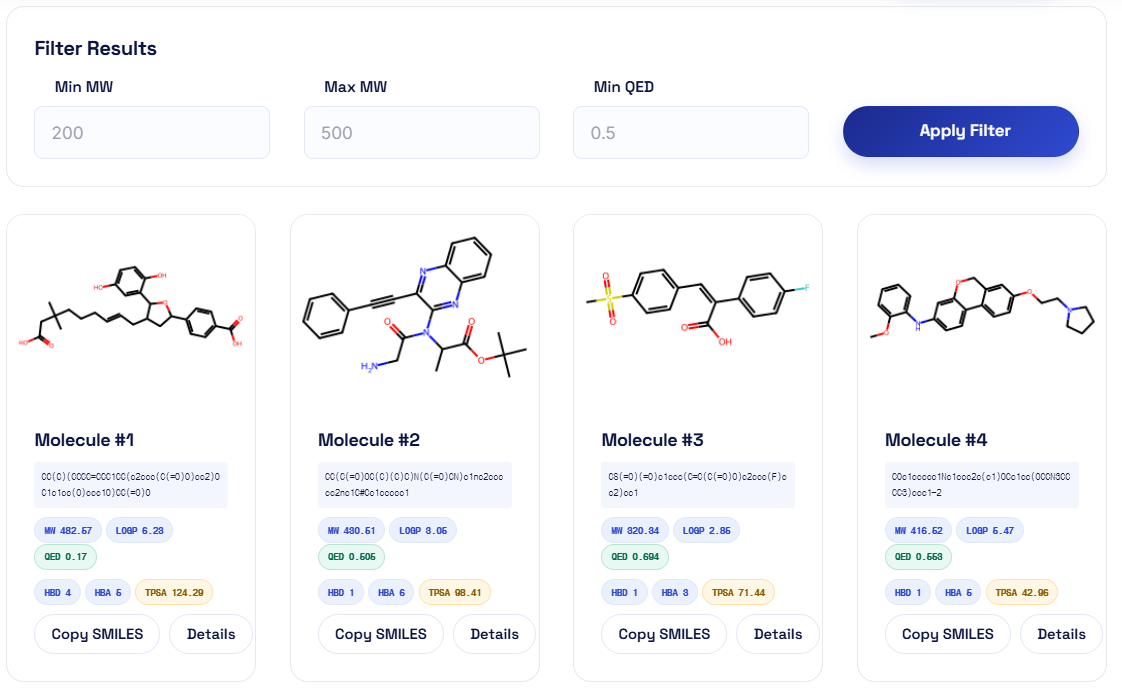
REINVENT4 creates de novo structures against project objectives and returns a reviewable candidate table with SMILES, molecular weight, LogP, QED, hydrogen-bond counts, TPSA and structural complexity.
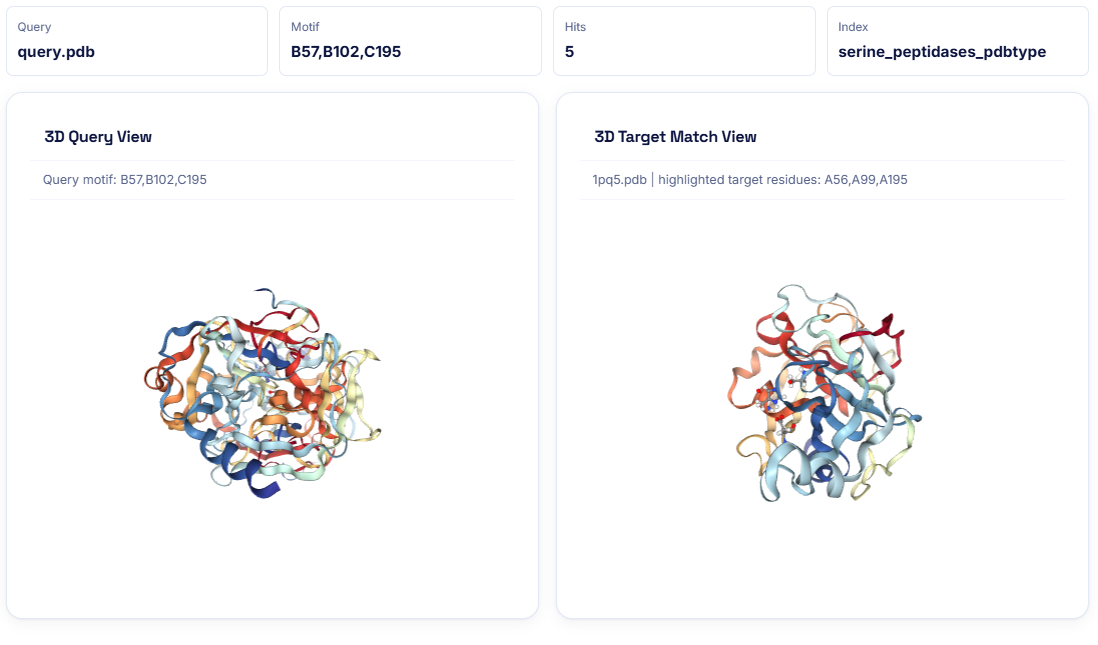
FoldDisco searches indexed protein structures for a residue-level geometric motif, displays the query beside each target match and ranks hits using structural agreement and matching-residue evidence.
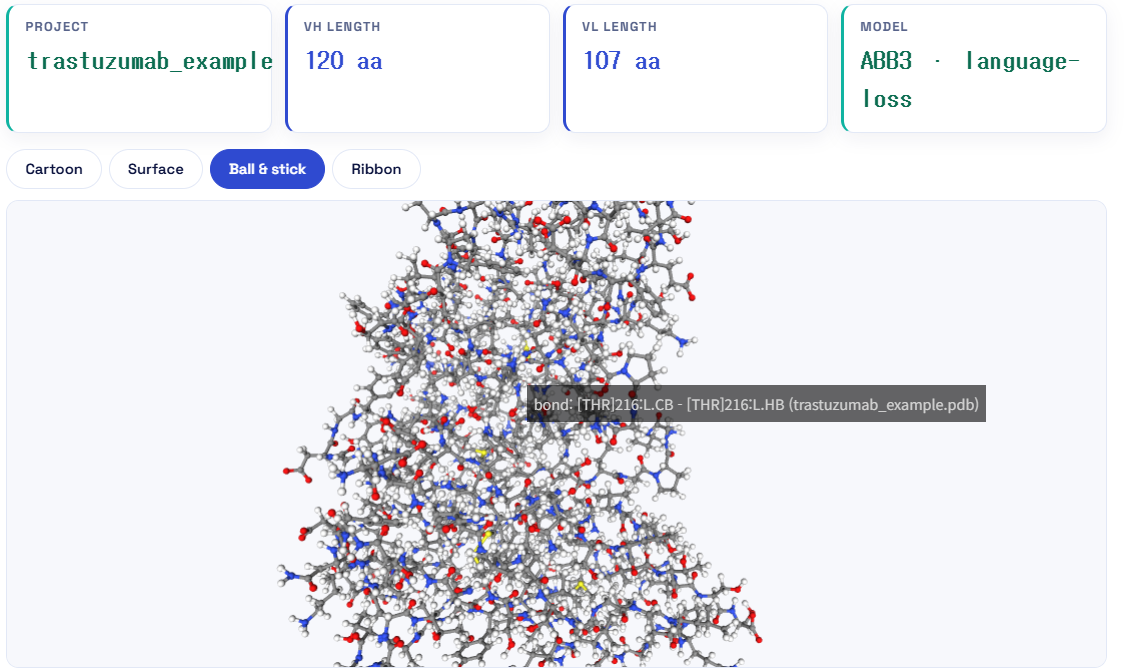
ABodyBuilder3 converts paired antibody sequences into structural hypotheses, helping researchers inspect framework geometry, CDR loops and candidate-specific features before experimental characterization.
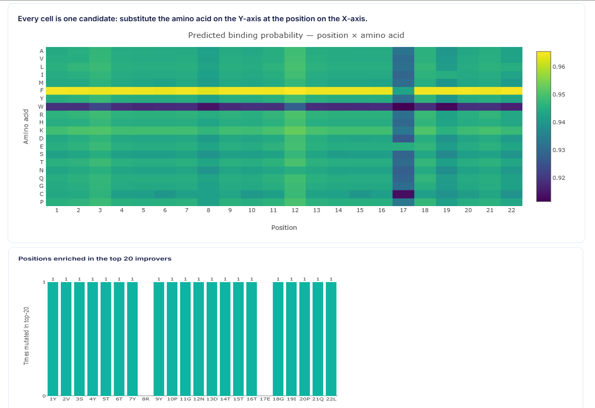
The Transformer model scores an antibody–antigen pair for predicted IC50 or binding probability, then scans point, double and triple mutants of the antibody to surface the variants it favours over the wild type.
Trusted infrastructure and research relationships across the ecosystem.




40 models across 8 research domains — start with a free demo, then choose the plan that fits your team.
Choose the type of conversation
AI responses may contain mistakes. Verify important research information.
Chat with a real person from our team. 자리를 비우셔도 이메일로 답변드려요.
Send your question through the contact page. An AI Cloud specialist will reply using the contact details you provide.
자리를 비우셔도 답변은 이메일로 보내드려요 · If you leave, we'll reply by email.